Robertson: The Birth of a New China
Twenty eight years after Pat Roberston's first visit to China, the country has become the world's fastest-growing economy.
Transcript
BEIJING - The year was 1978. The location: Guilin, China.
A young Pat Robertson, on his first trip to the Communist nation, used a famous Chinese tree to symbolize the dramatic changes that were unfolding in this legendary land.
In 1978, Robertson said, "This Banyan tree tells a great deal about China-- the history. Yes, it's snarled, it has a character. It has been through trials, through troubles. It's seen many hard winters. It's seen the light of many suns, and yet in still survives. It has tremendous capacity for change, and that's what's happening now in China: an emerging new revolution taking place, four modernizations. Will it come through? Well, the Banyan tree has after 800 years, and I dare say China will too."
He was right. China has come through, and come through big time.
Robertson said, "This "old tree" is coming alive. There's no question about it!"
In the 28 years since then, China has become the world's fastest-growing economy.
"The Chinese economy is growing very fast and it will only get better and better," said Beijing resident Yun Jie.
Since the late 70s, China's economy has doubled every eight years. Today, the average Chinese person has some 10 times the purchasing power they had just a quarter century ago.
Beijing resident Ouyang Hanxioung, said, "Our income is increasing and the things I could only once dream about buying, I can afford them now."
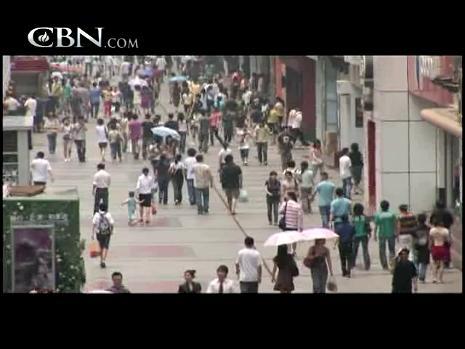
People are spending money like never before.
One woman said, "I feel these are happy times in China."
This may explain the sky's-the-limit statements we kept getting from people on the streets of Beijing.
"We are going to make it big!" one said.
Another commented, "The changes taking place today in China have been great and most of the people I know feel the same way too."
Journalist Huang Xiaoyu said, "My life is great. My career is going well."
Other residents spoke of being able to dreams big dreams, earn lots of money, achieve their potential.
Robertson said, "George, I can't believe this. I could never have imagined this explosion. This has been the most explosive civilization, I think of any nation, in history of the world."
But it's not materialism that has him beating a path to the world's most populace nation.
"One-point-three billion people who need Jesus Christ -- that's what I see," said Robertson. "I see people who can be lost to materialism unless they find the Lord."
He said he's holding on to a promise that the Lord made to him back in 1978.
He said, "I have a tremendous word for China: I believe the Lord gave me…while I was praying and reading the Word. This thing came from Hosea, and I think it is so marvelous about what the Lord is going to do in China. It says, I will have compassion on him who had not obtained compassion, and I will say to those who are not my people, you are my people and they will say thou art my God."
And this was just the latest of several trips to China since then. Each time, coming with a greater passion to share the love of Christ to millions of Chinese. This five-day visit to Beijing was no different.
Robertston met with top government officials, including one of China's vice premier's who called him an old friend of the Chinese people.
"We have great favor with the Chinese government," Robertson said, "because we have proved ourselves as a responsible partner to help the needs of the people."
The highlight of the trip came this past Saturday, when he asked some of this nation's best and brightest to consider three simple, yet profound questions:
Who am I? Why am I here? Where am I going?
This was a meeting with a group of students from Peking University, regarded here as the Harvard of China.
Robertson asked the students, "Who are you? You are an individual created in the image of God. Why are you here? We were put on Earth to give glory to God. Where are you going? Like it or not, we will all die. Before I met Jesus as my Savior, I was wrestling, and I was unhappy, and until the time came that I said yes, and then He entered into my heart and He has lived there ever since. And to know that if we believe in Him, we know where we are going. And so when I die, I'm going to be with Him forever."
Following his message, the students got a chance to ask him a few of their own probing questions.
Student: What's your attitude towards the famous modern saying "God is dead?"
Robertson: Well, as one person said, 'I'm surprised He's dead because I was talking to Him just this morning.'
Student: What kind of role can Christians play in China?
Robertson: What are Christians? They are good citizens, they work hard, they are honest, they look after their families, they care for their neighbors, they make a better society, they help one another so when there are Christians, there's the blessing of God.
Student: What is the secret of happiness?
Robertson: The true secret of happiness is surrender -- surrender to the will of God.
Student: I would like to know your opinion about the relationship between philosophy and religion.
Robertson: The word philosophy comes from two Greek words: 'Philos' and 'Sophia.' 'Sophia' means wisdom. 'Philos' means lover of wisdom. Philosophy can lead to endless debate and discussions and speculations that lead absolutely nowhere.
And what did the students think about this message?
Student Gong Ting said, "I feel really encouraged. Even though I'm not a Christian or believe in any religion, the message of everyone is special and that life is a process of pursuit is great."
"Of course, I'm not a Christian," said student Cai Xiao, "but I very much appreciate a man who has such strong beliefs."
When asked if he believed in God, student Shuxia Li replied, "Actually, no, because I'm not a Christian, but I can understand why the Western people believe in Him. But in fact, after reading the Bible, I really appreciate the idea of God."
Student Xiaotian Lu said, "I wanted to learn a little bit about what Christians think about Christianity."
Several of the students said they were touched by the gentleness of the message.
"I think for me," said one student, "it's just like a poem full of wisdom and encouragement."
And it was encouraging for Robertson as well. He said he sensed a hunger within people's hearts and hoped that his trip would serve as a catalyst to dramatically increase CBN's outreach to the Chinese people.
"My heart cry is for 250 million of these people to come to the Lord," Robertson said. "That's what I'm hoping for. And we are still looking for the access to fully reach them. I think with the hunger there is in these people, in the hearts of these people, they are ready. I just think that people who watch this broadcast need to be praying for China, because I have a great love in my heart for these Chinese people."
Download
Right-click on a link below and choose "Save link as..." to save the file
High Definition - MP4
High Quality - MP4
Low Bandwidth - MP4