The Vote that Resurrected Israel
French President Nicolas Sarkozy called the birth of modern Israel a "miracle," and said it was probably the central event of the 20th century.
Transcript
Last month, French President Nicolas Sarkozy called the birth of modern Israel a "miracle," and said it was probably the central event of the 20th century. The birth pangs for that miracle began 60 years ago this week with a key vote in the United Nations.
The 1947 Partition Vote
This week's Annapolis conference brought high hopes that if enough Middle East leaders get together, they can solve the intractable problems between the Israelis and Palestinian Arabs.
However, a big part of this fight dates back more than half a century to November 29, 1947. That day the United Nations voted to divide the region known as Palestine into two distinct nations.
The decision did not come easily. The world was still dealing with the horror of the holocaust, and a huge number of Jewish survivors had nowhere to go. They longed to move to their ancient homeland, but clashes there between Jews and Muslims had grown worse.
Britain controlled the region and feared a worldwide Muslim uprising if they allowed more Jews to settle there.
A striking symbol came in 1947 when five British destroyers blocked the Exodus, a ship filled with 4,500 Jewish refugees.
It was against this backdrop that the United Nations prepared to vote whether or not to give the Jewish refugees a place they could finally call home.
One look at the 1947 U.N. plan indicates why this is still a problem today. It strangely divided the territory for Jews in the north and south, for Arabs in Gaza, Judea and Samaria, and an international zone around Jerusalem.
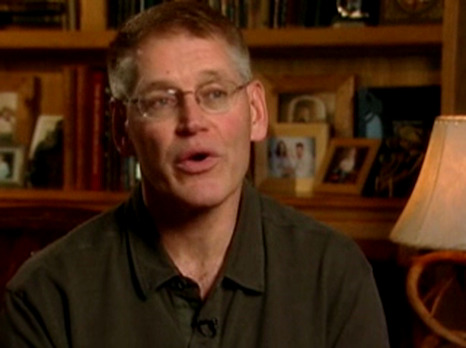
"It was by no means a sure thing that partition was going to pass," said novelist Brock Thoene.
He and his wife Bodie, also a novelist, have thoroughly researched that time.
"The U.N. at that time was 56 or 57 members," Brock said. "You had to get a 2/3 majority vote of those voting to pass a question. What you had to overcome in the U.N. was this bloc of Arab votes that very clearly were going to all vote 'no' on partition."
Also stacking the odds against a Jewish homeland, President Truman's own State Department urged him not to support partition.
A Surprising Twist
But historian Michael Oren says a surprising twist in the drama of the Cold War led Truman to get onboard with the idea.
"And it wasn't until October when Truman awoke one morning to be told by his aides that the Soviet Union had supported partition that Truman realized that the U.S. not only had to support partition, but the U.S. had to come out and be the front-runner," Oren said.
That decision put the lobbying for 'yes' votes into high gear.
"America even went to France and said, 'Listen, we have been rebuilding your country post-World War II. If you want the aid to continue, you are going to vote in favor of partition,'" Brock said.
Bodie added, "And they're all gathered together and they're deciding whether or not there will be an independent state of Israel. America had just lobbied to the max.
For the Jews of Palestine and their leaders, the coming vote on potential statehood became both a dizzying dream and a nightmare in waiting.
Israeli Aaron Axelrod was an a soldier at the time.
"So nobody thought about a state - really a state - because we knew a state means war, and nobody wanted a war," Axelrod said.
On November 29, millions of Zionist Jews and Christians gathered near their radios, listening for what many saw as the fulfillment of biblical prophecies.
After the vote, 2,000 years of pent-up celebrations for the Jews of Palestine followed.
Bodie notes that the very day the U.N. voted to allow a Jewish state, translation began on the newly discovered Dead Sea Scrolls - scrolls that included Isaiah's foretelling of the rebirth of the nation of Israel.
She said, "It's no coincidence that the Lord sends someone bearing all of the prophecies that have to do with the return of Israel as a nation. November 29, 1947- that happened."
A Call to War
But for the Arabs and Muslim nations, the vote was a call to war.
Violence between Arabs and Jews would intensify and then erupt into full-blown conflict when Israel declared itself a state in May 1948. The Arabs' rejection of the 1947 vote continues even to this week's conference in Annapolis.
Oren said, "The Arab states have never accepted the partition resolution and the Jews - or the state of Israel. The fact that the Palestinian delegation has come out and has said they will never recognize Israel as a Jewish state shows their continued refusal to accept the partition resolution. Because the resolution calls for, specifically, the creation of a Jewish state in Palestine."
Oren believes that because of the growth of the Arab-Muslim bloc, today's U.N. would never approve of a Jewish state. But 60 years later, Israelis continue to build on the vote that helped them become a nation.
Download
Right-click on a link below and choose "Save link as..." to save the file
High Definition - MP4
High Quality - MP4
Low Bandwidth - MP4